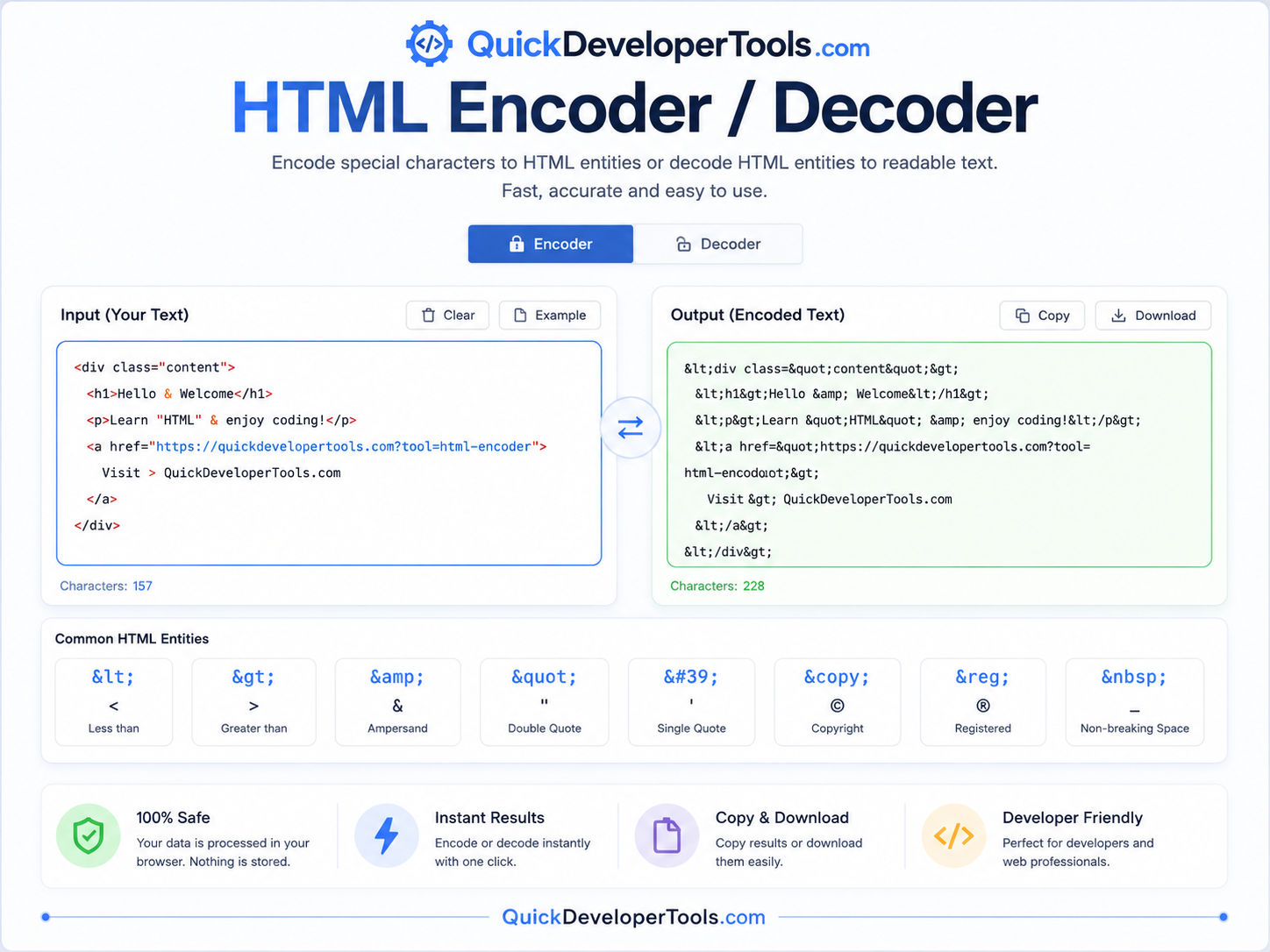
HTML ⇆ entities
Encoding everything is not safer than encoding the right things — it is just heavier and harder to read. The default here is the five characters that actually change how a parser reads your markup, with the rest available when you need them.
- Scope
- minimal · named · numeric
- Context
- body · attribute
- Decodes
- named · dec · hex
Input
Encoded
How a browser reads the result
This is the encoded output placed into a page as HTML. If the escaping is correct it reads back as your original text, with no tags interpreted.
The five that matter
' is XML, not safe in old HTML.
Worth knowing
Encode the ampersand first
It is the one order that matters. Escape < to < before
escaping & and you get &lt; — the text
< instead of a less-than sign. This tool always does the ampersand
first.
Attributes need more than the body
Inside value="…" a stray quote ends the attribute and everything after it
becomes new attributes. Attribute-safe mode escapes both quote characters plus backtick,
equals and whitespace-adjacent characters that can break an unquoted attribute.
' is not universally safe
It is defined in XML and XHTML but was never in HTML 4, so older parsers show it literally.
' works everywhere, which is why it is what this tool emits for an
apostrophe.
Escaping is not sanitisation
Escaping makes text display as text. It does not make untrusted markup safe to insert — if you actually need to allow some HTML through, you need a sanitiser with an allow-list, not an encoder.
UTF-8 makes "encode everything" unnecessary
Numeric entities for every accented character were a workaround for pages served in
Latin-1. On a UTF-8 page café is fine as-is, and entity-encoding it just makes
the source unreadable. The option is there for legacy targets.
Decoding is deliberately broad
Decode handles named entities, decimal & and hex
&, including the ones missing their closing semicolon, because
real-world markup contains all of it.
Other tools