

Skip to content
Browse tools

ASN & IP Owner Lookup

An ASN — Autonomous System Number — identifies the network that an IP address belongs to. Every block of addresses on the internet is announced by one, so it is the shortest answer to “who actually runs this?”

Enter a domain or an IP and get the AS number, the network owner and ISP, the CIDR range it sits in, which registry allocated it, the country, and the abuse contact to report it to.

Domains, full URLs and public IPv4 or IPv6 addresses. A URL is reduced to its host. A domain is resolved first, so the owner shown is the owner of the address it answers with — behind a CDN, that is the CDN. Ownership and abuse-contact data may come from RIR, WHOIS, RDAP, BGP, or provider records.
Enter a domain or a public IP address to view ASN, network ownership, CIDR allocation, registry, and abuse-contact details.
Network Owner
Unknown owner
โ€”

Ownership information will appear here after lookup.

ASN โ€” autonomous system number
Network Owner โ€” registered organization
ISP โ€” service provider
CIDR Range โ€” allocated network block
Registry โ€” regional internet registry
Allocation Date โ€” registration or assignment date
Country โ€” โ€”
Network Type โ€” ISP, hosting, mobile, enterprise

๐Ÿ“‹ ASN & Ownership Details

IP Address
โ€”
IP Version
โ€”
ASN
โ€”
AS Name
โ€”
Network Owner
โ€”
ISP
โ€”
Organization
โ€”
Network Type
โ€”
Reverse DNS
โ€”
Domain
โ€”
Country
โ€”
Registry
โ€”

๐Ÿงฑ Network Range

CIDR Block
โ€”
Allocated Address Range
โ€”
Address Count
โ€”
BGP Prefix
โ€”

๐Ÿ“จ Abuse & Administrative Contact

Abuse Email
โ€”
Abuse Phone
โ€”
Admin Email
โ€”
Technical Email
โ€”
Contact Name
โ€”
Address
โ€”
Last Updated
โ€”

โ„น๏ธ Interpretation

๐Ÿงพ Lookup Summary

๐Ÿ“ฆ Raw API Result

The registered network owner may differ from the company operating the website or service. Cloud providers, CDNs, resellers, leased address space, and BGP announcements can all affect ownership interpretation.
HOW IT WORKS

Real RDAP Registration Records Combined With Live BGP Routing

This lookup combines two independent, structured data sources rather than a single guess. First, the IANA RDAP bootstrap file is used to find which Regional Internet Registry (ARIN, RIPE NCC, APNIC, LACNIC, or AFRINIC) holds the registration record for the address, then that registry's own RDAP server is queried directly for the allocation's network owner, CIDR block, country, allocation/last-changed dates, and abuse/administrative/technical contacts - the modern, structured successor to scraping free-text WHOIS output. Second, RIPEstat's public BGP data is queried for the autonomous system currently announcing that address on the internet and its holder name, since the organization actually routing an address today can differ from the one on the original registration record (leased space, sub-allocations, and multi-homing all happen). Network owner and ISP are deliberately sourced from these two different places rather than assumed to be the same.

What else can you check?

These tools all work on the same connection and address data — pick whichever question you actually have.

Want to see the full path to a site? DNS, redirects, every hop, the CDN, TLS and the origin server. Want to know your public IP? See your IPv4 and IPv6 addresses, location, ISP and ASN. Want to check your tower & route? Live ping, speed, DNS, traceroute and a map of nearby points. Want to ping from around the world? Real latency from real probes across 12 countries, live on a map. Want to locate any IP address? City, region, country and coordinates for any public IP. Want to know if an IP is risky? Proxy, VPN, Tor, hosting and abuse-report indicators. Want to know if you're blacklisted? Check an address against major spam and abuse DNSBLs. Want to explore an AS number? Announced prefixes, BGP neighbours and registry details. Want to test your connection speed? Measure real download, upload, ping and jitter. Want to see what changed? Word-level diff between two blocks of text or code. Want to know if a DNS change is live yet? Compare answers from five independent public resolvers. Want to verify a domain's nameservers? Direct authoritative checks, glue records and SOA serials. Want to check a domain's DNSSEC setup? DNSKEY, DS records, signature expiry and real validation. Want to see the hop-by-hop path to a server? A real traceroute from a genuine probe anywhere in the world. Want to know if a server port is open? A real TCP connection attempt - open, closed or filtered. Want to measure latency to a server? Real connect timing - min/avg/max, jitter and connection loss. Want a clean URL slug from a title? Real transliteration, stop words and batch mode. Want to find and replace across a document? Regex, capture groups and a live preview before you commit. Want to find the invisible character? Code points, escapes, bytes and hidden-character detection. Want to escape text for HTML? Minimal, named or numeric entities, attribute-safe. Want to strip emoji cleanly? Whole clusters - no half-flags or stray modifiers left. Want to spot repeated words? Frequency, density and accidental doubles like "the the". Want to know if a URL is cached? Two requests prove whether your CDN is really caching it. Want to see what a site knows about you? Storage, cookies, tokens and what your browser actually cached. Want to run that check on any site? One-click bookmarklet reads storage and tokens where they live. Want to know who your site talks to? Renders the page and names every outside company it contacts. Is your site one address or four? www, non-www, http and https - which serve, which redirect. Need to build an Authorization header? Basic, Bearer, API key, Digest and AWS SigV4 - signed in your browser. Want to tidy up a messy SQL query? Beautify, minify, lint and convert keyword casing for six dialects. Need to work out a percentage? Nine calculators covering every way a percentage gets asked. Want to work out a rise or a raise? Increases, growth, compounding and CAGR, with the working shown. Want to work out a discount or a drop? Discounts, stacked sales and depreciation, with the working shown. What is actually on that page? Words, reading time, readability, every image, embed and link. Need a favicon that works everywhere? Every size, a real multi-resolution .ico, and the tags to paste. What headers does a site send back? Every response header on every redirect hop, explained. Need to test a regular expression? Live matches, capture groups, replace preview and code snippets. Need a JPG as a PNG? Batch convert in your browser, with optional transparent background. Need somewhere to jot things down? Private notes, links, to-dos and reminders saved in your browser. Need just some pages of a PDF? Split by page, range or chunk, or extract the pages you pick. What is hiding inside that image? EXIF camera settings, GPS tags, colour palette and web checks.
COMMON QUESTIONS

ASN & IP Owner Lookup FAQ

Why do "Network Owner" and "ISP" sometimes differ?

Network Owner comes from the address's RDAP registration record, while ISP reflects who is currently announcing that address on the internet via BGP. Leased address space, sub-allocations, and multi-homed networks can make these two organizations different.

Is this real WHOIS data?

It's RDAP, the structured, machine-readable successor to traditional free-text WHOIS - the same underlying registry data, returned as JSON directly from the responsible Regional Internet Registry instead of scraped text.

Why are some fields blank?

Registries don't populate every field for every allocation (especially older ones), and some don't publish direct abuse contacts at all. A blank field means the queried sources genuinely didn't return that information - it is never guessed.

Can I check a private or internal IP address?

No. Addresses in private, loopback, link-local or reserved ranges are rejected before any lookup happens.

Is the abuse contact reliable for reporting abuse?

It comes directly from the registry's own RDAP record, which is generally the most authoritative source available - but always confirm you're reporting to the organization actually responsible for the traffic you're seeing.
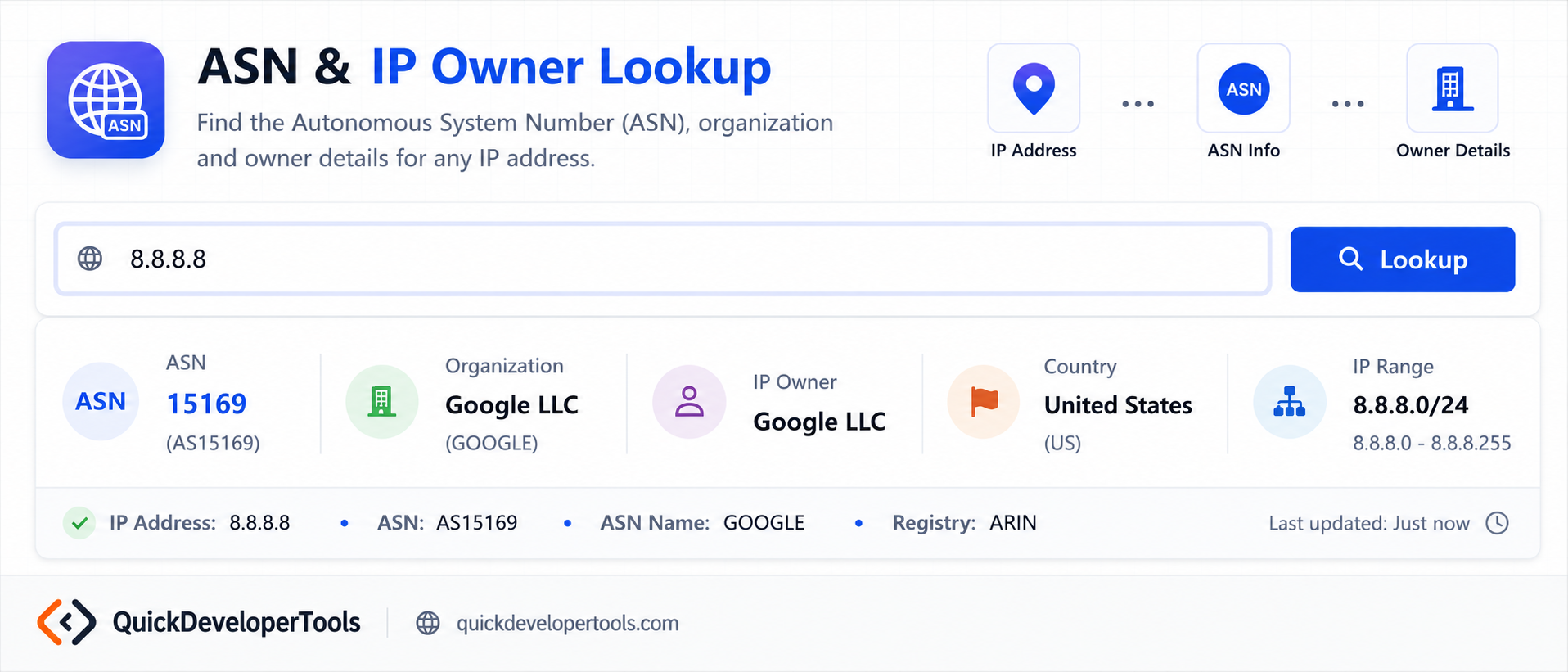
ASN and IP Owner Lookup naming the organisation behind an IP with its network, CIDR range and abuse contact
ASN & IP Owner Lookup: Who owns an IP: ASN, network, CIDR range and abuse contact.