AS—
—
—
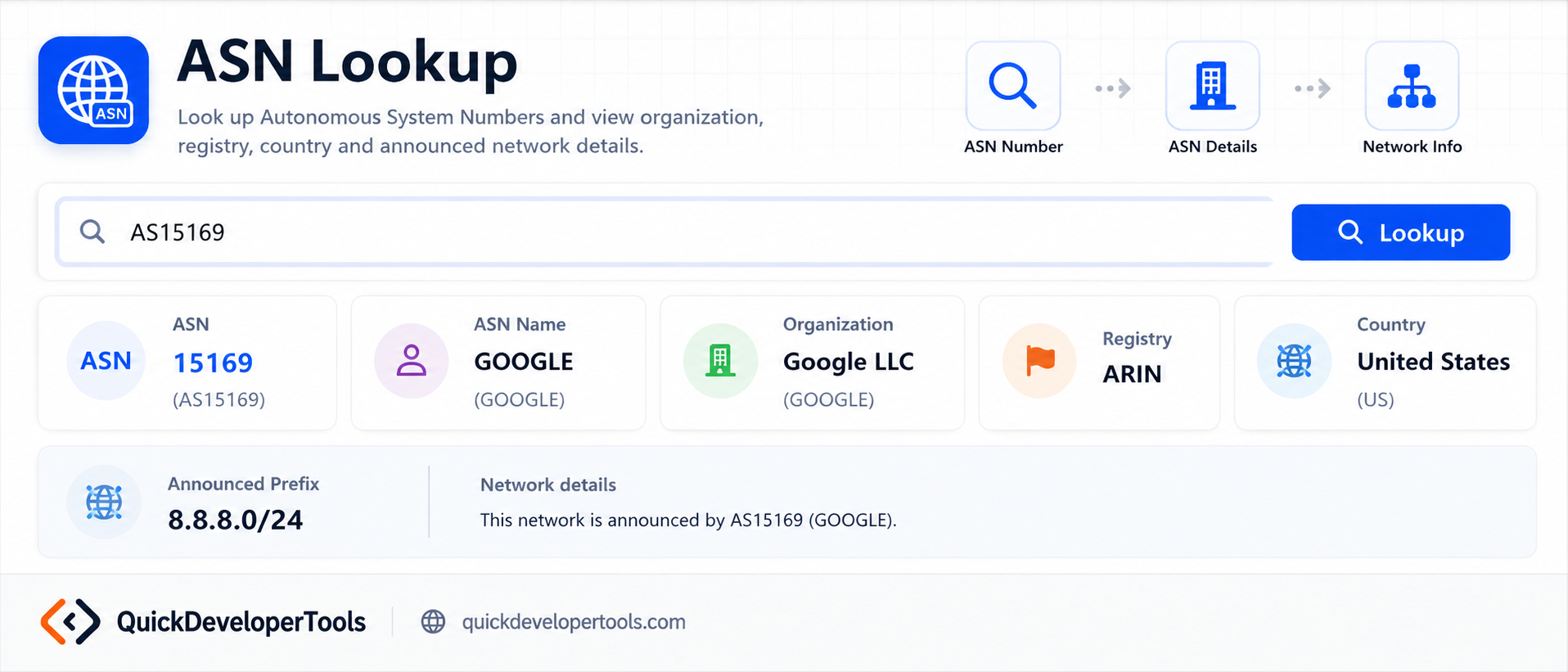
Every network on the internet has an AS number — an Autonomous System Number, the identifier for a block of addresses under one routing policy. Enter one to see who holds it, which registry issued it, exactly what it's announcing right now, and which networks it connects to. No AS number to hand? Paste a domain or an IP and we'll find the AS behind it first.
—
Networks observed directly adjacent to this AS in real BGP paths. Direction is what route collectors saw — it is not proof of a commercial provider/customer relationship, and RIPEstat labels some adjacencies "uncertain" for exactly that reason.
The internet isn't one network — it's roughly a hundred thousand independent ones that agree to carry each other's traffic. Each gets an Autonomous System Number from a regional registry, and uses BGP to announce "these IP ranges are reachable through me". This page combines three free RIPEstat data calls: as-overview for who holds the number and which IANA block it came from, announced-prefixes for exactly what it's routing at this moment, and asn-neighbours for the networks seen adjacent to it in real observed paths. If one call is slow or unavailable, only that section is left blank — the rest is still shown rather than failing the whole lookup.
These tools all work on the same connection and address data — pick whichever question you actually have.
That tool starts from an IP address and answers "who owns this address, and who do I report abuse to?". This one starts from the AS number and describes the network itself — everything it announces and who it connects to. You can paste an IP here too and we'll resolve it to its AS first.
That's the registry's own record: a short handle followed by the legal organisation name. We show it verbatim rather than tidying it, so it matches what you'd find querying the registry directly.
Route collectors saw the two networks adjacent in a BGP path but couldn't consistently determine which side was upstream. Rather than guess a direction, RIPEstat marks it uncertain and so do we.
Large transit networks announce thousands of prefixes — more than is useful to render in a browser. The full counts are always shown accurately, and the list is capped at 250 per address family with a note when it's been truncated.
Yes, and it's common. A number may be reserved for future use, kept for a network that's since been absorbed, or temporarily withdrawn. The "Currently Announcing" field reports exactly that state.