

Skip to content
Browse tools

Calculate Difference

Quick duration slider 90 days
1 day1 year5 years10 years
Calendar Difference
—
Detailed calendar breakdown
Total Days
—
Absolute difference
Business Days
—
Monday through Friday
Weeks
—
Equivalent duration

Raw Units Breakdown

—Days
—Weeks
—Approx. Months
—Approx. Years

Timeline Overview

—Start date
—
Choose two dates
—End date

Calculation Options

Include end date
Count the final date in total and business days
Absolute difference
Always show a positive duration

Quick Presets

Use Move Date to calculate a new date instantly.

📌 About calendar maths. “1 month” isn't a fixed length — from 31 January, adding a month lands on 28 or 29 February, not 31 February. This calculator clamps to the last valid day of the target month, which is what almost every date library and billing system does. The total-days figure is always exact regardless.
HOW IT WORKS

Two Honest Ways To Measure Time

There are two correct answers to "how long between these dates", and they rarely match. The calendar difference — 2 years, 3 months, 14 days — is how people naturally think, but it depends on where you start, because months vary from 28 to 31 days. The total difference in days or hours is a single exact number with no ambiguity, which is what you want for billing, SLAs and anything that must be reproducible. Both are shown here rather than picking one, since choosing silently is how off-by-one errors get shipped. Business days count Monday to Friday only and ignore public holidays, which vary by country and can't be assumed.

What else can you check?

These tools all work on the same connection and address data — pick whichever question you actually have.

Want to see the full path to a site? DNS, redirects, every hop, the CDN, TLS and the origin server. Want to know your public IP? See your IPv4 and IPv6 addresses, location, ISP and ASN. Want to check your tower & route? Live ping, speed, DNS, traceroute and a map of nearby points. Want to ping from around the world? Real latency from real probes across 12 countries, live on a map. Want to locate any IP address? City, region, country and coordinates for any public IP. Want to know if an IP is risky? Proxy, VPN, Tor, hosting and abuse-report indicators. Want to know if you're blacklisted? Check an address against major spam and abuse DNSBLs. Want to know who owns an IP? Network owner, ASN, CIDR range and abuse contact. Want to explore an AS number? Announced prefixes, BGP neighbours and registry details. Want to test your connection speed? Measure real download, upload, ping and jitter. Want to see what changed? Word-level diff between two blocks of text or code. Want to know if a DNS change is live yet? Compare answers from five independent public resolvers. Want to verify a domain's nameservers? Direct authoritative checks, glue records and SOA serials. Want to check a domain's DNSSEC setup? DNSKEY, DS records, signature expiry and real validation. Want to see the hop-by-hop path to a server? A real traceroute from a genuine probe anywhere in the world. Want to know if a server port is open? A real TCP connection attempt - open, closed or filtered. Want to measure latency to a server? Real connect timing - min/avg/max, jitter and connection loss. Want a clean URL slug from a title? Real transliteration, stop words and batch mode. Want to find and replace across a document? Regex, capture groups and a live preview before you commit. Want to find the invisible character? Code points, escapes, bytes and hidden-character detection. Want to escape text for HTML? Minimal, named or numeric entities, attribute-safe. Want to strip emoji cleanly? Whole clusters - no half-flags or stray modifiers left. Want to spot repeated words? Frequency, density and accidental doubles like "the the". Want to know if a URL is cached? Two requests prove whether your CDN is really caching it. Want to see what a site knows about you? Storage, cookies, tokens and what your browser actually cached. Want to run that check on any site? One-click bookmarklet reads storage and tokens where they live. Want to know who your site talks to? Renders the page and names every outside company it contacts. Is your site one address or four? www, non-www, http and https - which serve, which redirect. Need to build an Authorization header? Basic, Bearer, API key, Digest and AWS SigV4 - signed in your browser. Want to tidy up a messy SQL query? Beautify, minify, lint and convert keyword casing for six dialects. Need to work out a percentage? Nine calculators covering every way a percentage gets asked. Want to work out a rise or a raise? Increases, growth, compounding and CAGR, with the working shown. Want to work out a discount or a drop? Discounts, stacked sales and depreciation, with the working shown. What is actually on that page? Words, reading time, readability, every image, embed and link. Need a favicon that works everywhere? Every size, a real multi-resolution .ico, and the tags to paste. What headers does a site send back? Every response header on every redirect hop, explained. Need to test a regular expression? Live matches, capture groups, replace preview and code snippets. Need a JPG as a PNG? Batch convert in your browser, with optional transparent background. Need somewhere to jot things down? Private notes, links, to-dos and reminders saved in your browser. Need just some pages of a PDF? Split by page, range or chunk, or extract the pages you pick. What is hiding inside that image? EXIF camera settings, GPS tags, colour palette and web checks.
COMMON QUESTIONS

Date Difference FAQ

Why doesn't "months × 30" match the total days?

Because months aren't 30 days. The calendar difference walks the actual calendar month by month; the total-days figure counts real elapsed days. Both are correct measures of the same interval — they're just answering slightly different questions.

Are public holidays excluded from business days?

No. Business days here means Monday to Friday. Public holidays differ by country, region and sometimes by employer, so assuming a set would produce a confidently wrong number rather than an honest one.

What does "include end date" do?

It adds one day, which is what you want for inclusive ranges — a booking from the 1st to the 5th is 5 days to a hotel but 4 days of elapsed time. Off by default, since elapsed time is the more common need.

Does it handle leap years?

Yes — every figure is counted from the real calendar, so 29 February is included whenever it genuinely falls inside your range. All the maths runs in UTC, which is what keeps a daylight-saving change from silently adding or removing an hour.

Can I calculate someone's age?

Yes — put the birthday in "Start Date", today in "End Date", and read the calendar difference. That gives the same years-months-days figure a passport office would.
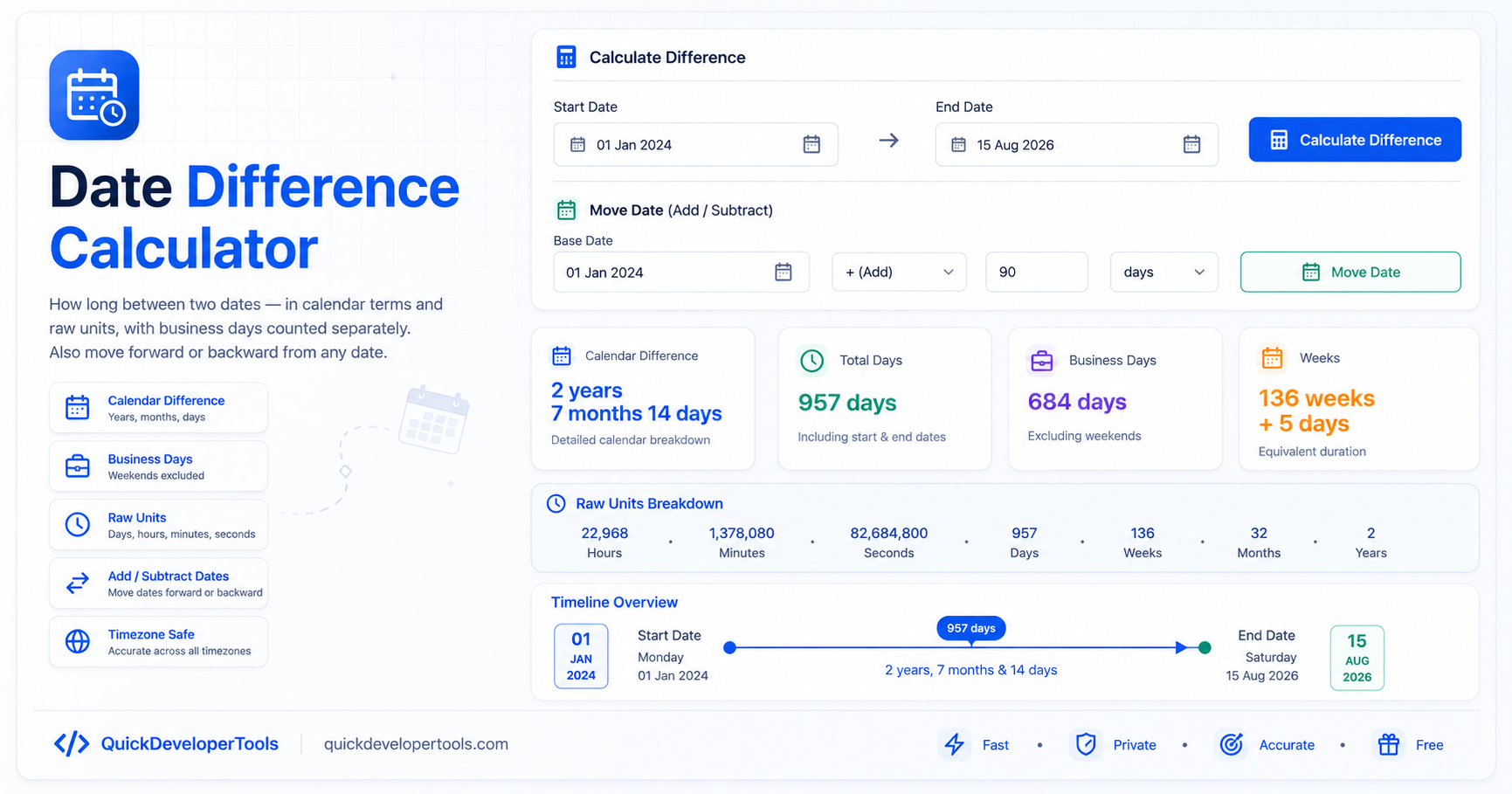
Date Difference Calculator showing the years, months and days between two dates alongside the business-day count
Date Difference Calculator: Time between two dates, business days, age and date arithmetic.